
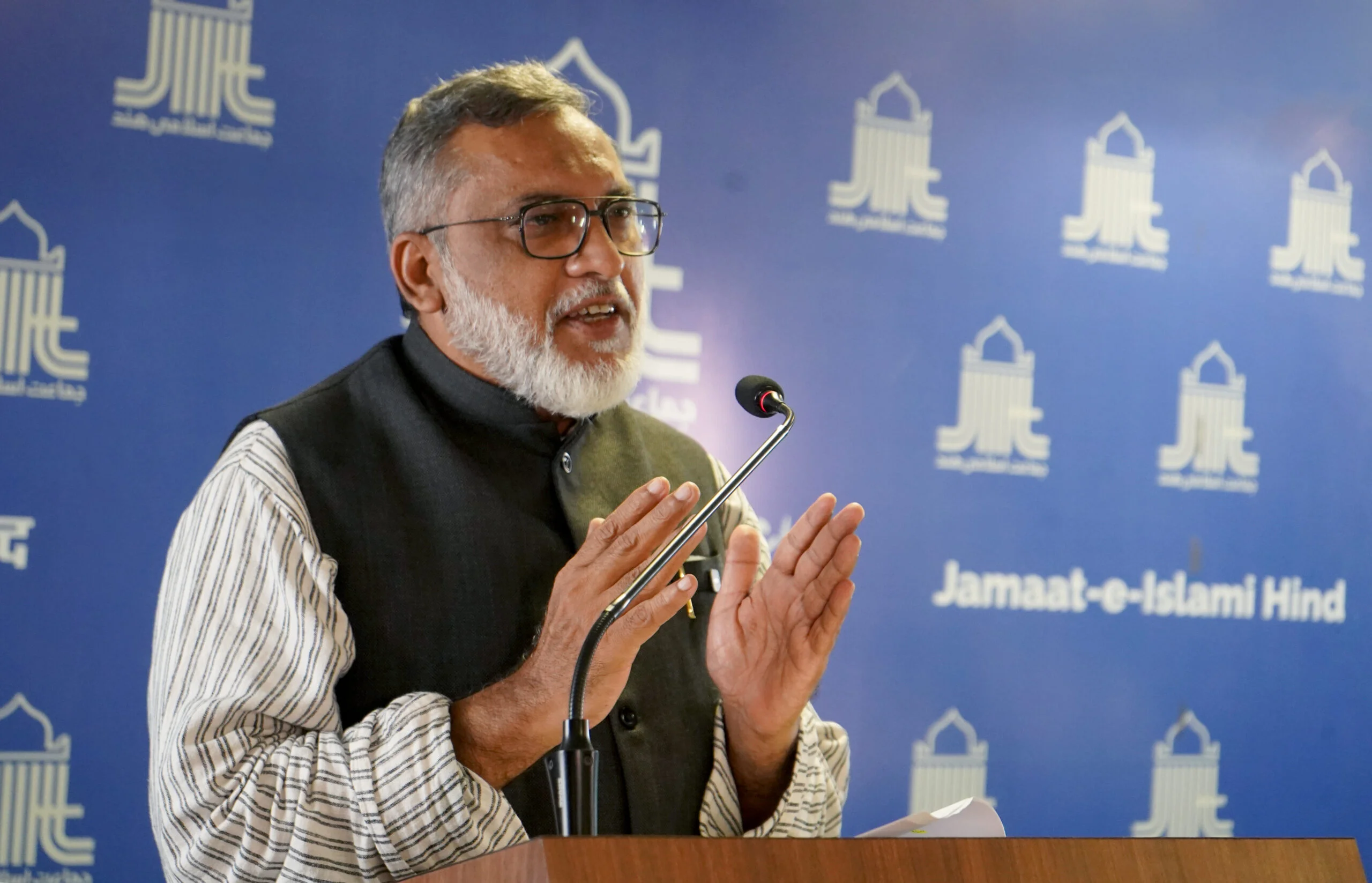
Leadership and guidance are not merely the domain of a select few. Leadership is a sacred duty that paves the way for future generations. On the theme of leadership and guidance, the verses of Allama Iqbal serve as guiding principles for the Muslim community. In Allama Iqbal’s view, the purpose of leadership is to safeguard faith and the community. His poetry vividly captures the qualities essential for religious leadership. These thoughts were expressed by Malik Motasim Khan, Vice–President of Jamaat–e–Islami Hind, during a weekly public gathering held at the organization’s headquarters on the theme “Leadership and Guidance of the Ummah: In Light of Iqbal’s Thought.”
In his speech, Malik Motasim Khan highlighted various aspects of Allama Iqbal’s poetry. He remarked that Iqbal was not just any poet; he used poetry as a potent medium to communicate his message to the people. The basis of Iqbal’s philosophy is rooted in the Quran and Sunnah, which are evident throughout his verses. Quoting Iqbal’s poetry, Khan stressed that genuine leadership must be free from material aspirations or selfish motives. A decline in character can lower leadership from its esteemed position. Iqbal expresses the traits of leadership in his poetry, with one of his well-known couplets stating:
yaqīñ mohkam amal paiham mohabbat fātah-e-ālam
jihād-e-zindagānī meñ haiñ ye mardoñ kī shamshīreñ
(Steadfast conviction, relentless action, love that conquers the world,
These are the swords of true men in the battle of life.)
Citing the historical narratives of the life of Prophet Muhammad (peace be upon him), Malik Motasim Khan noted that history documents instances of Muslims securing victories in battles despite being significantly outnumbered by their foes. Iqbal distinctly references these battles in his poetry. Iqbal’s notion of ishq (love) is deeply noble and meaningful, symbolizing strength, resolve, and the development of character:
sidq-e-KHaliil bhii hai ishq sabr-e-husain bhii hai ishq!
ma.arka-e-vajuud me.n badr o hunain bhii hai ishq!
(The truth of Abraham is love, the patience of Husayn is love,
In the arena of existence, the battles of Badr and Hunayn are love.)
Khan elaborated that Iqbal’s perspective on leadership is very dynamic in its nature. He connects leadership to truth, justice, and bravery—qualities that are essential for a leader. Delving into Iqbal’s ideas of khudi (selfhood) and ishq, Khan explained that khudi is central to Iqbal’s philosophy. Iqbal redefined selfhood, giving it new dimensions. Leadership requires this sense of selfhood; without it, one cannot effectively meet the demands of leadership. Referencing Iqbal’s verses on the unity of the Muslim community, Khan pointed out that Iqbal portrayed the ummah as a unified whole, dismissing divisions based on race, ethnicity, or sect:
butaan-e-ra.ng-o-KHuu.n ko to.D kar millat me.n gum ho jaa
na tuuraanii rahe baaqii na iiraanii na afGaanii
(Shatter the idols of race and lineage, merge into the community,
Let neither Turani, nor Iranian, nor Afghan remain.)
Citing Iqbal’s Persian poetry, Khan noted that Iqbal’s poetic heritage is even more profound in Persian than in Urdu, granting him the status of a global poet. In conclusion, Khan characterized Iqbal as a poet of the future, whose significance will persist through time. Iqbal’s philosophy will keep guiding new generations:
mai.n zulmat-e-shab me.n le ke nikluu.ngaa apne dar-maa.nda kaarvaa.n ko
sharar-fishaa.n hogii aah merii nafas miraa shola-baar hogaa
(In the darkness of night, I will lead my weary caravan forward,
My sigh will spark flames, my breath will blaze like fire.)
The gathering attracted a substantial audience, comprising students, women, and intellectuals. The event wrapped up with an interactive question-and-answer session. Zahir Ahmed facilitated the program.


0 Comments